
Key Takeaways
- AI maturity is becoming a key factor in private equity due diligence.
- An AI-powered GCC gives PE firms a reusable execution layer for portfolio-wide AI transformation.
- GCC-led AI capability can compress value creation timelines and strengthen exit narratives.
Introduction: Why the PE Playbook Needs a New Variable
Private equity value creation has long relied on cost optimization, pricing improvements, bolt-on acquisitions, and restructuring. These levers still matter, but they are harder to differentiate when most firms run similar playbooks.
AI changes the equation. Not AI as a pitch-deck theme, but AI as embedded operational capability that improves revenue, margins, speed, and scalability. Yet there is a persistent gap between AI experimentation and measurable business impact. McKinsey’s 2025 Global Survey on AI confirms this. That gap is where private equity needs a sharper operating model.
For PE firms evaluating their next investment or optimizing a current portfolio, the question worth asking is whether they have the infrastructure to make AI work repeatedly across companies. An AI-powered GCC creates that execution layer, supporting diligence, accelerating post-acquisition transformation, and strengthening the value story at exit.
AI Due Diligence in Private Equity: Why AI Maturity Matters
Deal teams have traditionally assessed targets on financial performance, market position, management quality, operating efficiency, and technology risk. AI due diligence in private equity adds a structured view of AI maturity to that list.
This does not mean PE firms should only look at AI-native businesses. Most acquisition targets are not, and that is fine. The real question is whether the firm understands the AI readiness gap and what it will take to close it. If AI maturity is not already part of your deal team’s diligence checklist, it is worth adding it now.
Gartner has linked successful AI initiatives to strong foundations in data quality, governance, AI-ready talent, and change management. A practical assessment should also evaluate production AI use cases, architecture, cybersecurity, and responsible AI controls.
For PE firms, AI maturity is both a diligence issue and a value creation issue. If the firm already has AI-ready GCC infrastructure, the gap between current state and AI potential becomes a structured execution challenge rather than an open-ended investment risk.
Private Equity Value Creation with AI: How GCCs Compress the Timeline
Once a deal closes, the pressure to create value starts immediately. Traditional levers can deliver results, but they often have a ceiling. Most PE firms apply them, so much of that upside is often already priced in.
Private equity value creation through AI opens a different category of levers: better forecasting, intelligent automation, AI-assisted reporting, embedded AI features, and contract intelligence. For firms looking to move beyond the standard playbook, these are worth prioritizing early in the hold period.
The challenge is execution speed. Building AI capability from scratch can burn months on infrastructure, hiring, vendor selection, and governance. A GCC with AI capability already in place compresses that timeline.
With a GCC, PE firms can bring shared platforms, data engineering capacity, AI product squads, model governance, and delivery playbooks to each portfolio company. A PE-backed B2B services company, for example, could use a GCC-led AI team to automate invoice processing, improve sales forecasting, and build executive dashboards soon after acquisition. If your firm does not yet have this shared layer, consider mapping which capabilities could be centralized versus which need to stay local.
Each portfolio company benefits from what was built for the last one. AI stops being isolated pilots and becomes enterprise capability that scales across the portfolio.
GCC for Private Equity Firms: Why It Is Not Outsourcing or Consulting
When PE firms hear “GCC,” many still think of cost-arbitrage or shared-services centers. That perception is outdated. The modern GCC is increasingly a strategic hub for engineering, data, AI, and product development.
What matters most for PE is how a GCC differs from the alternatives. Hiring a consulting firm creates dependency and leaves when the engagement ends. Building in-house teams inside each portfolio company is slow and duplicative. A GCC sits between those two models. It is owned by the firm, retains institutional knowledge across deals, and can be deployed to the next company without starting from scratch. If your firm relies on one of these two approaches, it is worth evaluating whether a GCC model would deliver better continuity and cost efficiency over a multi-deal horizon.
A PE-oriented AI operating model built on a GCC can include a central AI transformation office, shared data engineering teams, MLOps and responsible AI governance, and post-acquisition playbooks. The firm creates a permanent capability layer rather than buying it project by project.
AI Exit Valuation: Strengthening the Buyer Narrative
At exit, every PE firm tells a value creation story. The strength of that story influences buyer confidence, diligence outcomes, and valuation conversations.
This is where AI exit valuation becomes important. The point is not that AI automatically increases a company’s multiple. The point is that governed, embedded, and measurable AI capability can strengthen buyer confidence in the durability of future performance.
A strong AI-GCC exit story should show production AI use cases, KPIs tied to revenue or margin, documented adoption, model governance, and a delivery team that can continue post-acquisition. If your portfolio companies have AI in production but lack this documentation layer, building it well before exit preparation begins is a practical step that pays off.
The AI capability becomes part of the asset, not just part of the presentation.
The AI-GCC Model Across the Investment Lifecycle
The value of an AI-GCC model is not limited to one phase of the deal. From screening to exit, it plays a different role at each stage, and the business impact compounds as the investment matures.
Here is how that breaks down across the four key stages.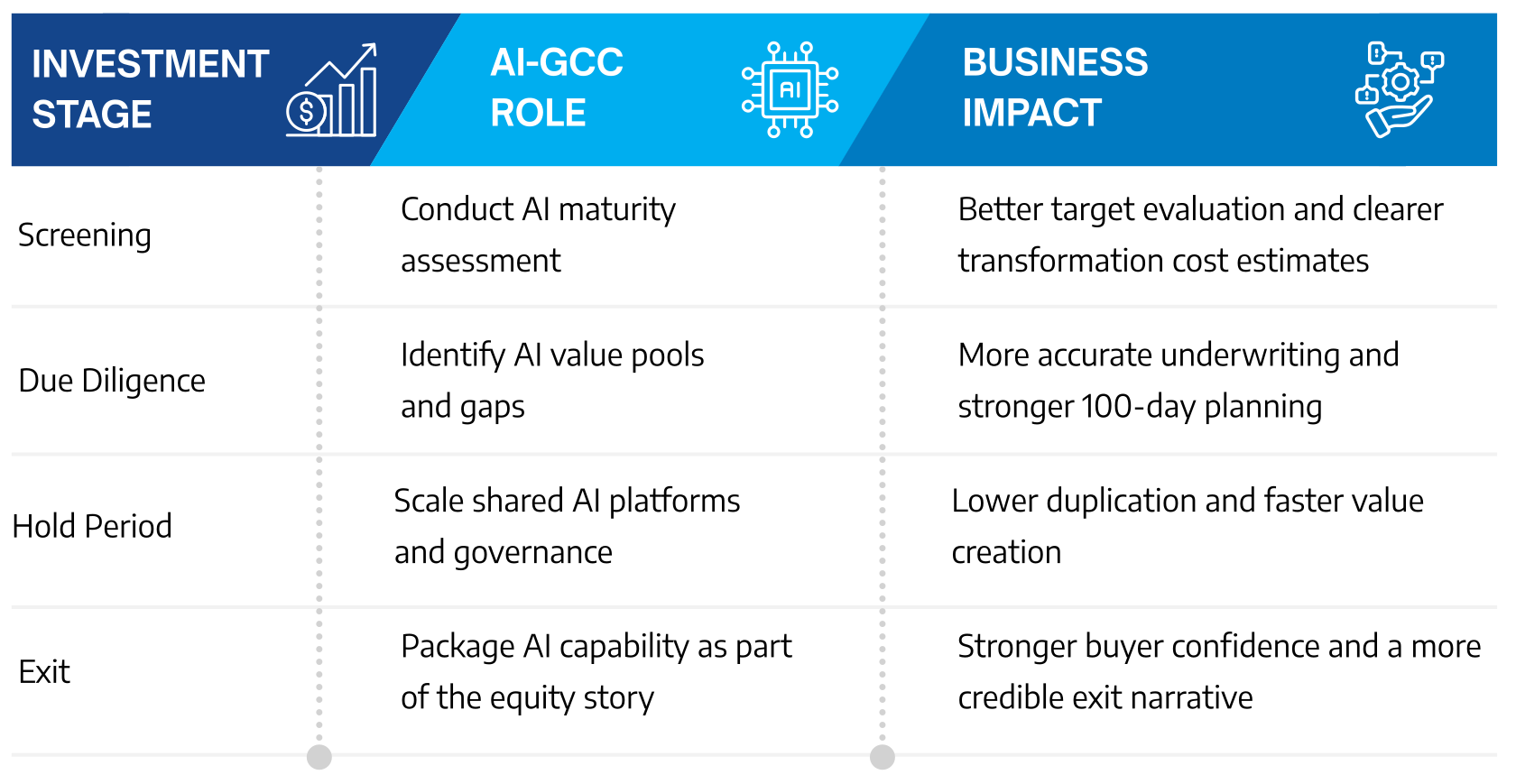
Conclusion: The Economics Demand It
AI, GCCs, and private equity are converging because the economics demands it. PE firms need faster value creation. Portfolio companies need scalable AI capability. Buyers want confidence that improvements will last beyond the current ownership cycle.
Limited partners (LP) are paying closer attention, too. The question from LPs is no longer whether portfolio companies are experimenting with AI, but whether the firm has a structured model for AI-led value creation. A credible PE portfolio AI strategy, supported by AI-ready GCC infrastructure, signals that the firm can deploy AI after acquisition, measure impact, and strengthen exit narratives through sustainable capability.
An AI-powered GCC helps answer these needs. It improves deal evaluation, accelerates transformation, strengthens portfolio operations, and gives LPs evidence of a mature value creation engine. The firms that build this layer now will have an advantage over those that treat AI as a portfolio-by-portfolio experiment.
Source:
• McKinsey & Company – The State of AI in 2025: Agents, Innovation, and Transformation
• Gartner – AI Success Hinges on Bigger Investments