


How Global Capability Centers in India Scale from Delivery Hubs to Enterprise Capability Engines
Key Takeaways: Scaling India GCC in 2026
- Scaling an India GCC in 2026 is an operating model decision, not a hiring decision.
- Global Capability Centers in India deliver real value when leadership, governance, and talent systems mature before headcount expands.
- A scalable GCC depends on a clear mandate, defined decision rights, strong local ownership, and consistent global standards.
- AI readiness, culture integration, and retention systems decide whether the center becomes an enterprise capability hub or stays an offshore execution unit.
Introduction: Why India GCCs Need a Different Scaling Playbook
Scaling an India GCC in 2026 requires more than adding headcount. The most effective approach is to align the center’s mandate, operating model, and local leadership before expansion begins. Governance, talent strategy, and AI readiness should be defined with the same level of clarity. Done well, this turns a delivery-led GCC into an enterprise capability hub that owns outcomes, not just execution.
Most India GCCs are already running at meaningful scale. The harder question is whether they can grow from 100 to 500 to 1,000 employees without losing speed, quality, ownership, or culture along the way.
India now hosts 2,117 GCCs, generating $98.4 billion in market revenue and employing 2.36 million professionals, with the sector projected to reach $105 billion by 2030 across 2,400 centers.
Headcount-Led Scaling vs Capability-Led Scaling
Most scaling missteps trace back to one choice. Companies either add people to meet demand or build capability to create long-term value.
The table below shows how these two approaches differ in practice.
The shift is simple. Headcount-led scaling proves capacity. Capability-led scaling builds long-term enterprise value.
Why Global Capability Centers in India Are Central to Enterprise Scale
Global Capability Centers in India have moved well beyond their original role as offshore delivery centers. They now anchor product engineering, analytics, AI, cybersecurity, cloud, finance operations, and digital transformation for global enterprises.
Beyond scale, India offers a combination that is difficult to replicate. This includes deep engineering and AI talent, competitive cost structures, time zone coverage for global operations, and a mature English-speaking workforce experienced in enterprise delivery. EY’s GCC Pulse Survey 2025 also notes that Indian GCCs are redefining their strategic roles by driving innovation, harnessing AI, and building future-ready organizations.
Data Snapshot: India GCC Scale and Readiness
Enterprises need a scaling model that converts this maturity into repeatable execution, not just larger teams.
The India GCC Scale Readiness Model: 7 Steps to Scale in 2026
A scalable India GCC rests on a clear set of foundations: mandate, leadership, operating model, talent, governance, and culture, with AI readiness and global standards running across all of them. Weakness in any one area slows the rest.
The seven steps below show how to put this model into practice.
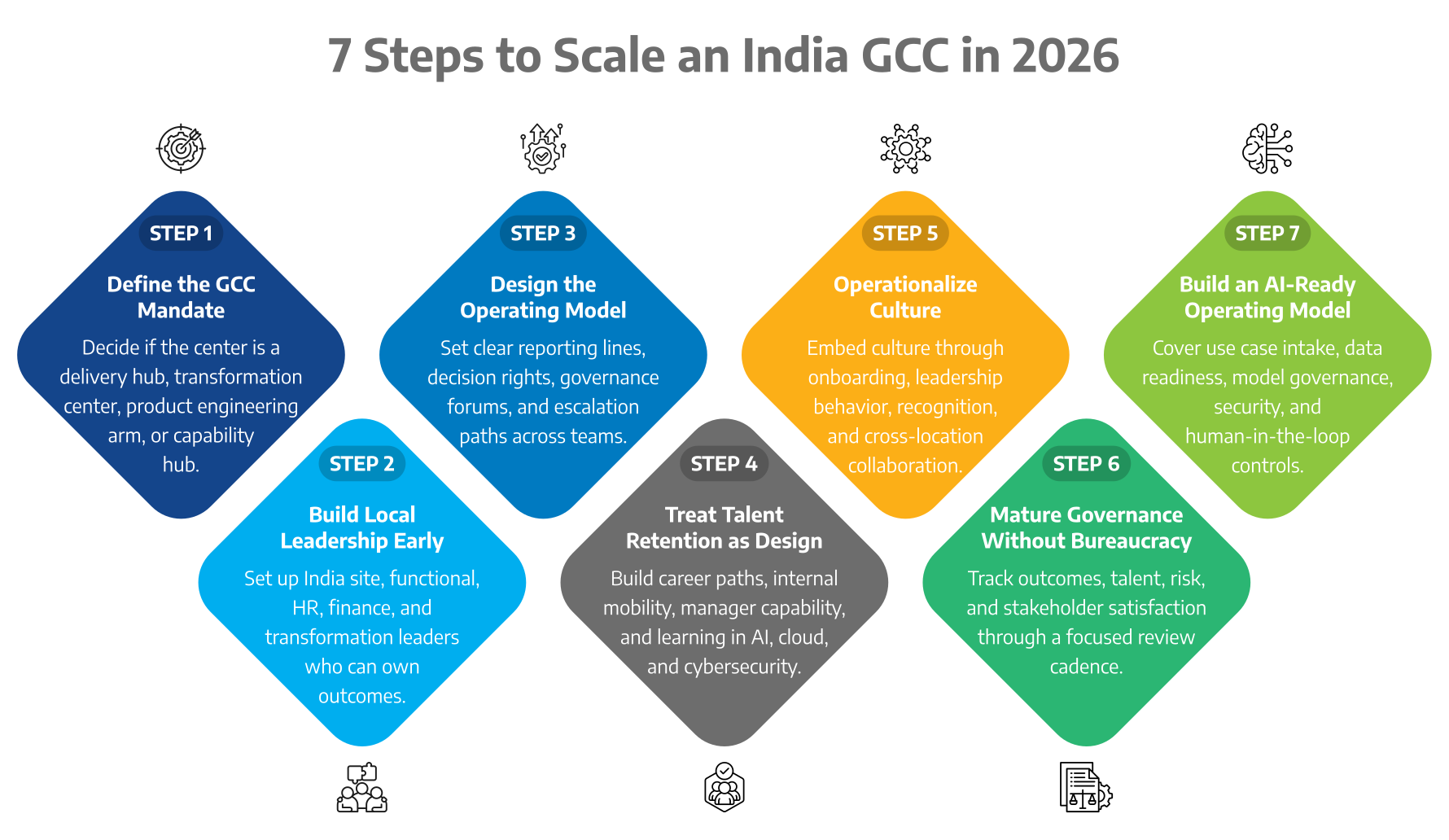
Companies building or restructuring this foundation can explore Global Capability Center solutions to align India-based teams with enterprise-scale delivery and balance cost, talent, and operating needs across regions.
Why Talent, Culture, and AI Maturity Decide Scale Success
Most scaling challenges look operational, but the deeper issues usually come down to three things: talent, culture, and AI maturity.
Competition for high-performing Indian talent is intense, and retention cannot depend on compensation alone. People stay when they see meaningful work, strong managers, career mobility, and a credible path to leadership.
Culture faces similar pressure during fast growth. New employees may join faster than the organization can absorb them, and global teams may treat the India center as a vendor extension rather than an integrated enterprise team. The fix is to operationalize culture through onboarding, leadership behavior, recognition routines, and cross-location collaboration, not communication campaigns alone.
AI maturity now sits alongside these priorities. With 83% of GCCs investing in GenAI and 58% in Agentic AI, India centers are expected to centralize AI talent, build reusable automation, and move pilots to production. Scaling AI without a defined operating model creates fragmented tools, weak data quality, and unclear ownership. A governed model covering use case intake, data readiness, security review, and human-in-the-loop controls keeps AI execution business-aligned.
For companies building this layer, AI-powered transformation capabilities can support the shift from fragmented pilots to scalable, governed execution.
Conclusion: India GCCs Are Becoming Enterprise Capability Engines
The companies that scale India GCCs well in 2026 will not be the ones that grow fastest. They will be the ones that grow with structure, clarity, and ownership of outcomes.
India offers the talent, ecosystem, and maturity to support large-scale enterprise capability building. Sustainable GCC growth, though, requires intentional design. For organizations planning the next stage of India GCC expansion, the advantage will shift from headcount to capability, and from execution to ownership.
Ready to Scale Your Technology Footprint in India?
If your India GCC is ready for its next phase of growth, a strategic value creation partner can help you design a strategic roadmap built around your operating model, talent needs, leadership structure, AI readiness, and long-term transformation goals.
Sources
• Zinnov-Nasscom – India GCC Landscape Report 2026
• Press Information Bureau – India GCC Sector Outlook
• EY – GCC Pulse Survey 2025
• Business Standard – EY GCC Pulse Survey Coverage on Agentic AI Adoption
FAQs
A scalable India GCC is a Global Capability Center designed to grow in size and scope without weakening leadership, governance, culture, or business impact. It combines a clear mandate, mature operating model, local leadership depth, structured talent systems, and consistent global standards.
Global Capability Centers in India offer deep engineering and AI talent, mature delivery ecosystems, competitive cost structures, and strong time zone coverage. This makes them well-suited for enterprise capability building, large-scale operations, and long-term transformation programs.
The biggest challenges include leadership depth, governance complexity, talent retention, inconsistent processes, stakeholder alignment, and cultural integration. A 1,000-person GCC needs a structured operating model, clear decision rights, strong local leadership, and stronger talent planning than a 100-person center.
Culture should be built into operating routines, not limited to communication campaigns. Companies should invest in structured onboarding, leadership training, global immersion, cross-location collaboration, recognition programs, and regular business context sessions so India teams feel connected to the parent company’s mission.
The most effective retention strategies include meaningful work, visible career paths, internal mobility, competitive rewards, manager quality, learning programs, and exposure to global stakeholders. Strategic roles, not only execution responsibilities, are what keep top talent engaged.
Start by defining non-negotiable global standards for security, compliance, quality, data, delivery, and governance. Then assign local ownership for adoption and monitoring, so India leaders can apply those standards in ways that fit local realities while staying accountable to enterprise expectations.