
Introduction
The role of the CFO has expanded significantly in recent years. Finance leaders are now expected to drive sustained EBITDA expansion while supporting revenue growth without proportional increases in cost.
Margin pressure is rising, capital has become more expensive, and traditional approaches built on manual process improvement and linear cost reduction no longer deliver the required returns. Expectations around predictability and execution have tightened across both mid-market and PE-backed organizations.
Performance is increasingly judged not only by outcomes, but by how reliably those outcomes can be delivered. Forecast variance must narrow, operating leverage must improve, cash must move faster through the system, and controllership must strengthen as complexity increases.
Meeting these demands requires more than incremental efficiency gains. It calls for an operating model that embeds intelligence directly into execution, improves itself over time, and remains financially governed as it scales.
This is the context in which AI-powered Global Capability Centers (AI-GCCs) have emerged as a new operating standard.
The Four EBITDA Levers AI-GCCs Strengthen
- Structural Operating Leverage: AI automates high-volume, low-variability work across finance, shared services, IT support, and HR operations. Standardized workflows reduce cost variability, enabling revenue growth to flow more directly to EBITDA without expanding overhead.
- Throughput and Cash Conversion: AI accelerates core cycles such as month-end close, billing, collections, onboarding, and issue resolution by removing manual handoffs and reconciliation bottlenecks. Shorter cycles improve cash visibility and strengthen working capital discipline.
- Variance Reduction and Forecast Predictability: When integrated with ERP systems, AI improves data hygiene and surfaces anomalies earlier. Planning inputs stabilize, period-end surprises decline, and CFOs gain greater confidence in forecasts and reporting.
- Revenue Quality and Margin Discipline: AI strengthens pricing discipline, deal qualification, pipeline prioritization, and revenue recognition accuracy. With SG&A controlled, improvements in revenue quality translate into more predictable gross margin contribution to EBITDA.
Why AI-GCC Value Builds Over Time
Once AI is embedded into core operational workflows, CFOs begin to see tangible execution improvements. The more important question is whether those improvements scale and endure.
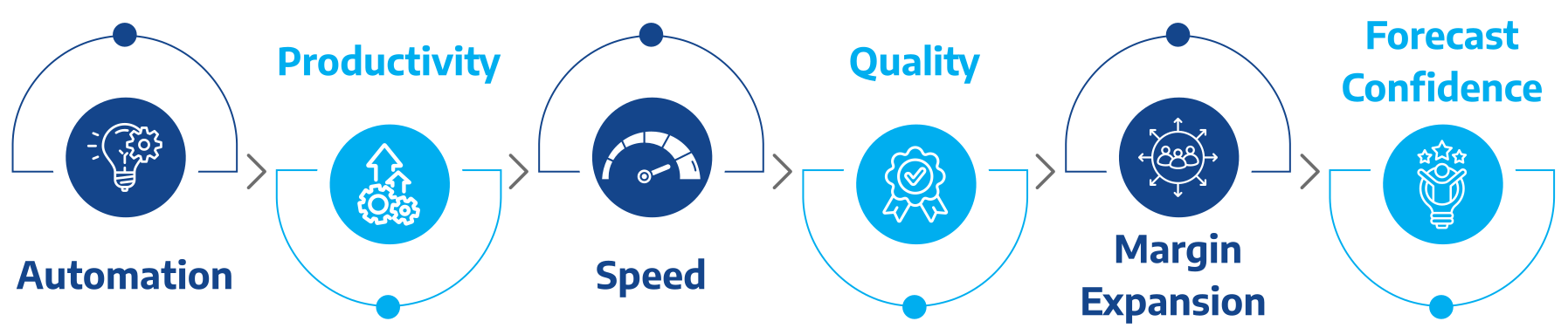
As models learn from operational feedback, marginal costs decline, execution becomes more consistent, and forecast variance narrows. Performance improves not because assumptions are adjusted, but because the operating system itself becomes more predictable.
This compounding effect is most visible in forecasting and controllership. 66% of finance leaders expect generative AI to have its most immediate impact on explaining forecast and budget variance, reinforcing that value emerges as AI becomes embedded in execution rather than applied as a standalone tool (Gartner).
This is what differentiates AI-GCCs from traditional automation or cost takeout efforts. With CFO governance in place through ROI gates, phased funding, and controllership discipline, performance continues to strengthen over time, turning execution into a durable financial asset.
CFO Accountability from Financial Plans to Execution
For CFOs, accountability does not end with setting budgets or forecasts. It extends to delivering against them, under increasing scrutiny from boards, lenders, and, in many cases, PE sponsors.
AI-GCCs help close the gap between financial plans and operational reality by providing real-time visibility, structured workflows, and consistent performance signals. Earlier insight enables faster intervention, preventing small execution issues from compounding into missed targets.
From Labor Arbitrage to Intelligence Arbitrage
The difference between traditional GCCs and AI-powered GCCs is not incremental. It reflects a fundamental shift in how value is created.
| Legacy GCC Model | AI-GCC Model |
|---|---|
| Labor cost arbitrage | Intelligence arbitrage |
| Manual standardization | AI-augmented workflowsy |
| Efficiency flattens with scale | Continuous performance improvement |
| Cost center orientation | EBITDA value engine |
| Growing supervisory burden | Lower variance and fewer exceptions |
The shift is fundamental. Stop staffing centers. Start designing value engines.
The CFO-Aligned AI-GCC Operating Model
What matters is not whether AI improves execution, but whether those improvements hold as scale and complexity increase.
In an AI-GCC model, intelligence is embedded directly into core workflows, reducing manual work, accelerating cycles, and improving consistency. AI is layered onto ERP systems to improve data quality, surface anomalies earlier, and tighten forecast ranges.
Execution remains governed through phased funding, clear ROI checkpoints, and cost transparency, ensuring operational gains translate into sustained EBITDA contribution.
A Quick Self-Assessment for CFOs
- Where is operational variance costing us EBITDA today?
- How confident are we that our ERP and controllership processes support reliable forecasting as the business scales?
- Are our AI initiatives compounding into sustained EBITDA improvement, or remaining isolated pilots?
Capturing the Advantage Before it Becomes Table Stakes
AI-powered GCCs are reshaping how finance leaders scale their organizations. They support growth without proportional cost increases, reduce execution volatility, and create operating models better suited for sustained EBITDA performance.
Organizations that move early see these benefits build as execution becomes more predictable and forecasting improves. Those that delay often remain constrained by fragmented processes and limited visibility.
What ultimately differentiates leaders is not margin improvement alone, but confidence in their numbers. As operating environments become more demanding, the ability to forecast EBITDA reliably becomes a competitive capability.
The advantage lies in how early that capability is built, and how deliberately it compounds over time.